What to Track When Your Baby Starts Waking More Often
A few days of simple notes on sleep, feeds and health can show whether more night waking is a phase, a pattern or a reason to call the pediatrician.
1:58 am, then 3:20, then 4:45. Last week your baby woke once, maybe twice. This week you have lost count, and when your partner asks in the morning how the night went, the honest answer is “bad” and nothing more specific than that.
That is the problem with sudden night waking: it blurs. Every night feels like the worst one, and it gets hard to tell whether things are getting better, worse or just different. A few days of simple notes can fix that. Not to optimize your baby, and not to grade yourself, but to turn a blur into something you can actually read.
Why babies start waking more
Night waking in the first two years is common, and it comes and goes. A useful starting fact: all babies wake briefly between sleep cycles. What changes from week to week is whether they settle themselves back to sleep or wake fully and call for you.
Several ordinary things can tip a baby from settling to calling:
- Developmental change. Around 4 months, sleep architecture matures into lighter, adult-like cycles, and that change is permanent (The 4-Month Sleep Regression). Later disruptions, around 8 to 10 months, 12 months and 18 months, tend to be temporary and tied to new skills and separation anxiety (8-Month Sleep Regression).
- Schedule drift. Naps that have crept too long or too late, or a bedtime that has moved, change sleep pressure at night. Early waking is its own pattern, covered in Early Morning Waking.
- Feeding changes. Growth, a new feeding pattern or a recent change to night feeds can all show up as more waking. Night Weaning covers that side.
- Illness and discomfort. Colds, ear infections and other illnesses can disrupt sleep. The AAP lists trouble sleeping among the symptoms of an ear infection, alongside pain, irritability, fever and fussiness during feeds [5].
- Teething, briefly. In a prospective study of 125 babies whose parents recorded symptoms daily from 4 months to 1 year, increased wakefulness was associated with teething, but only within a window of about 8 days around a tooth coming through [4]. No symptom happened in more than 35% of teething babies, and none could reliably predict a tooth [4].
The log is how you tell these apart. A developmental disruption tends to look like more wakes with a well, cheerful baby during the day. Illness tends to come with other signs. Schedule drift shows up when you line naps up against nights.
What normal night waking looks like
Before you track, it helps to know that “waking at night” is not, on its own, a sign that something is wrong.
A systematic review of 34 observational studies pooled diary and questionnaire data to estimate normal ranges. Average night wakings ranged from 0 to 3.4 a night for babies in their first two months, and from 0 to 2.5 a night for 1- to 2-year-olds [1]. Those are wide ranges, and they are meant to be: babies vary a lot.
A Canadian cohort study of 388 infants asked whether babies were sleeping through the night at 6 and 12 months. Depending on whether “through the night” meant 6 or 8 uninterrupted hours, between 27.9% and 57.0% of babies were not [2]. The researchers found no association between sleeping through the night and the babies’ mental or psychomotor development, or their mothers’ mood [2].
So the question your log is answering is not “Is my baby waking?” It is “Has something changed, and is there anything alongside it that I should act on?”
A simple log for one week
Researchers who study infant sleep rely on sleep diaries and short parent questionnaires because parents are the people who are there at night. When one widely used infant sleep questionnaire was developed, its answers lined up well with both sleep diaries and actigraphy, a wrist or ankle movement sensor, in a group of 100 babies aged 5 to 29 months [3]. Two measures did the most to distinguish babies referred for sleep problems from other babies: the number of night wakings and how long they slept at night [3]. That questionnaire asks about the previous week, which is a sensible length for a home log too.
Night
- Bedtime and morning wake time
- Each wake: time and roughly how long
- What settled them: feed, rocking, a hand on the chest, nothing
- Night feeds
Day
- Naps: start time, length, where
- Day feeds, rough times or amounts
- Daytime mood in one word
Health and changes
- Temperature if they feel warm
- Runny nose, cough, ear pulling, rash, vomiting
- Fewer wet diapers, unusual drowsiness
- A new skill, caregiver, trip or food
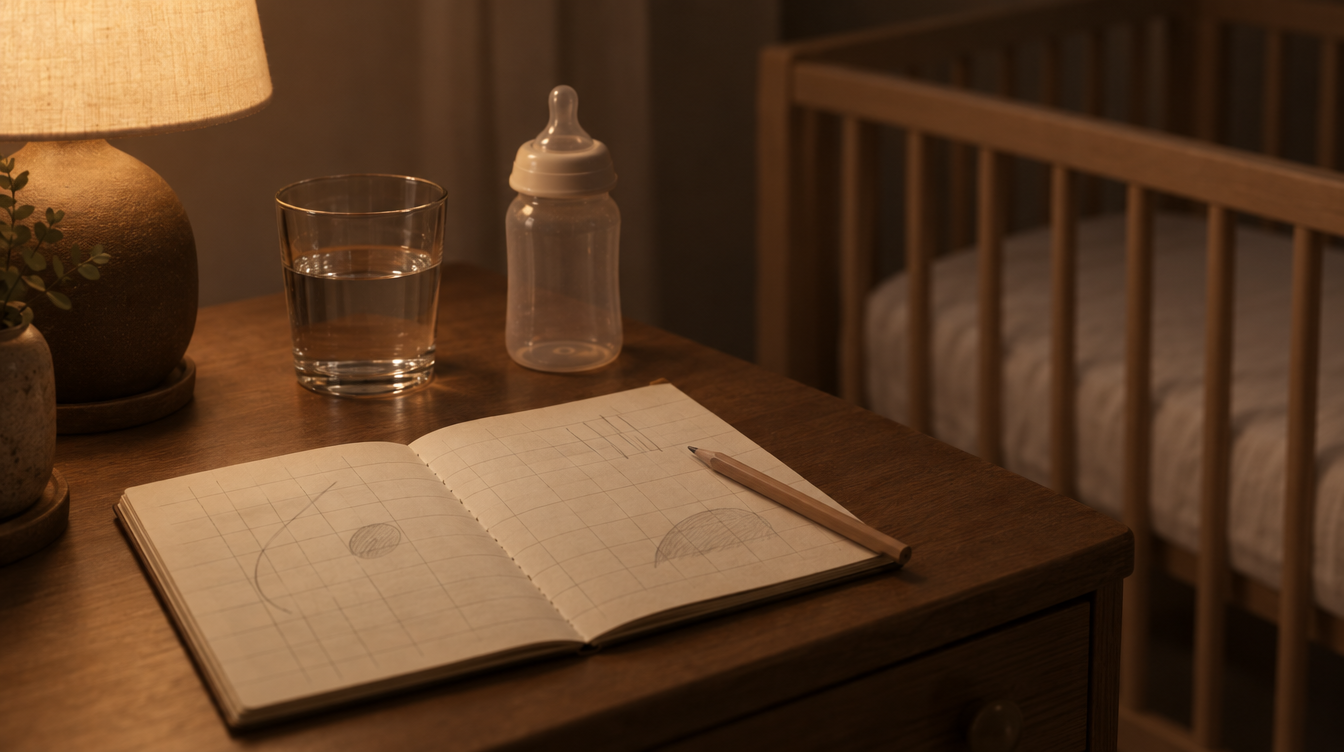
Keep it short enough to fill in one-handed at 3am. Paper by the bed or a notes app both work. Here is what I would write down:
Bedtime and morning wake time. When they went down and when the day started. These two anchor everything else.
Each night wake. The time, roughly how long, and what got them back to sleep: feed, rocking, a hand on the chest, nothing. Don’t worry about exact minutes. “About 20 minutes, fed back to sleep” is enough.
Feeds. Day and night. If you breastfeed, approximate times are fine; if you bottle feed, a rough amount helps.
Naps. Start time and length, and where they happened: crib, car, arms, stroller.
Health notes. Temperature if they feel warm, runny nose, cough, ear pulling, rash, vomiting, diarrhea, fewer wet diapers, unusual drowsiness or fussiness.
Daytime mood. One word is enough: cheerful, clingy, cranky, off.
Anything new. A new skill (rolling, crawling, pulling to stand), a new caregiver, travel, a schedule change, a new food.
That is it. You are not trying to build a dataset. You are trying to see, after five to seven days, whether there is a shape.
Reading the log
When the week is done, look at it in daylight, ideally with your partner or whoever shares the nights. A few patterns are worth looking for:
Wakes clustered at the same times each night. This can point toward schedule factors. Compare against the nap column: a late or long afternoon nap, or a much earlier bedtime than usual, often shows up here.
Wakes that only settle with a feed. Useful to know, not a problem in itself. Whether night feeds are still needed depends on your baby’s age, growth and your pediatrician’s advice.
More wakes alongside a new skill. Rolling, crawling and standing often bring a few weeks of practice in the crib. This is the classic later regression pattern.
More wakes alongside health notes. This is the column that matters most. If the waking started at the same time as a cold, fever, ear pulling or feeding trouble, the sleep change may simply be your baby being unwell.
No pattern at all. That happens too. Sometimes a week of notes mostly tells you that this is a phase, and the next week looks better.
When to stop logging
If the log starts making you more anxious, stop. A week is enough to answer the question. Recording every night indefinitely tends to keep your attention on the problem rather than on getting through it.
When to call the pediatrician
A baby who was sleeping well and suddenly is not deserves a pediatric check-in if anything else seems off. The log makes that conversation faster and more useful, but don’t wait for a full week of notes if your baby seems unwell.
The AAP says to call your child’s doctor right away if your child has a fever and looks very ill, is unusually drowsy or very fussy; has severe ear pain, breathing difficulty, an unexplained rash, or repeated vomiting or diarrhea; or has had a seizure [6]. Call right away for any temperature of 100.4 degrees F (38.0 degrees C) or higher in a baby younger than 3 months [6]. Also call if a fever lasts more than 24 hours in a child younger than 2 [6].
Ear infections cannot be diagnosed over the phone; the eardrum has to be examined [5]. If your notes show waking that started with a cold, fussiness during feeds and a temperature, that is a reason to book a visit.
And a note on teething: in the prospective study, fever over 102 degrees F was not associated with teething, and no teething child had a temperature of 104 degrees F [4]. The authors’ conclusion was that other causes must be ruled out before putting a baby’s symptoms down to teeth [4].
What to expect
For temporary developmental disruptions, the 8-10 month disruption typically lasts 2 to 6 weeks. If your log shows more wakes alongside a new skill and a happy baby during the day, that is the timeline to expect, give or take.
If the log points to schedule drift, small changes to nap timing often show up in the night within a week or two. If it points to illness, sleep usually follows recovery, though some babies keep a new night habit for a while afterward.
Signs things are improving: wakes getting shorter, settling with less help, one fewer wake on most nights. These are easier to see on paper than in memory, which is the whole point of writing them down.
A note for tonight
If you are reading this between wakes, you do not need to start a log tonight. Tonight you just need to get through. Tomorrow, put a pen and a scrap of paper by the bed. Write the times when you can. If your baby seems sick, call your pediatrician in the morning, or sooner if the warning signs above apply. Otherwise, this is very likely a phase, and you are allowed to be tired of it.
If you’re concerned about your baby’s sleep or health, speak with your pediatrician or family doctor. The American Academy of Pediatrics has sleep safety guidance at healthychildren.org. If your own sleep deprivation is affecting your daily functioning or mental health, that is also worth raising with your doctor.
Frequently asked questions
How many night wakings are normal for a baby?
There is a wide normal range. A large review of observational studies reported average night wakings from 0 to 3.4 a night in the first two months, and from 0 to 2.5 in 1- to 2-year-olds. In one Canadian cohort, between about a quarter and over half of babies at 6 and 12 months were not sleeping through the night, depending on the definition used.
How long should I keep a sleep log?
About a week is usually enough to see a pattern without the log becoming a chore. Researchers who designed a widely used infant sleep questionnaire asked parents about the previous week.
Could teething be why my baby is waking more?
Possibly, briefly. In a prospective study of 125 babies, increased wakefulness was linked to teething, but only in a window of about 8 days around a tooth coming through, and no symptom was reliable enough to predict a tooth. Fever over 102 degrees F was not linked to teething, so do not put a real fever down to teeth.
When should more night waking make me call the pediatrician?
Call if the waking comes with fever, ear pain, poor feeding, breathing trouble, vomiting, a rash or unusual sleepiness, or if your baby seems unwell during the day. Call right away for any temperature of 100.4 degrees F or higher in a baby younger than 3 months.
Is a sleep tracking app better than paper?
Either works. What matters is that it is quick enough to fill in at 3am and that you can show it to your pediatrician. The site does not recommend specific apps or devices.
Sources and further reading
- Galland BC, Taylor BJ, Elder DE, Herbison P — Normal Sleep Patterns in Infants and Children: A Systematic Review of Observational Studies
Sleep Medicine Reviews, 2012. Systematic review and meta-analysis of 34 studies of questionnaire or diary data; reports reference ranges for night wakings and sleep duration by age.
- Pennestri MH, Laganière C, Bouvette-Turcot AA, et al. — Uninterrupted Infant Sleep, Development, and Maternal Mood
Pediatrics, 2018;142(6):e20174330. Longitudinal cohort of 388 infants; 27.9% to 57.0% of 6- and 12-month-olds did not sleep through the night, depending on a 6- or 8-hour definition; no association with development or maternal mood.
- Sadeh A — A Brief Screening Questionnaire for Infant Sleep Problems: Validation and Findings for an Internet Sample
Pediatrics, 2004;113(6):e570-e577. Validation against sleep diaries and actigraphy in 100 infants aged 5-29 months, plus an internet sample of 1,028; number of night wakings and nighttime sleep duration best distinguished clinical from control groups.
- Macknin ML, Piedmonte M, Jacobs J, Skibinski C — Symptoms Associated with Infant Teething: A Prospective Study
Pediatrics, 2000. Prospective cohort of 125 infants with daily parent records from 4 to 12 months; symptoms clustered in an 8-day window around tooth emergence; no symptom reliably predicted a tooth.
- American Academy of Pediatrics — Ear Infection Symptoms
HealthyChildren.org parent guidance, last updated December 2025. Lists pain, irritability, trouble sleeping, fever and ear drainage as symptoms.
- American Academy of Pediatrics — Fever: When to Call the Pediatrician
HealthyChildren.org parent guidance, 2022. Lists signs that mean call the doctor right away, including any fever of 100.4 degrees F or higher under 3 months.
Sources checked October 29, 2026. This is an editorial summary, not a systematic review or individual advice.