Baby Sleep While Traveling: Keeping Familiar Routines and Safe Sleep
A new room, a borrowed crib and a shifted clock can unsettle any baby; the routine travels well, and the safe sleep rules travel with it.
9:40 pm, a hotel room four hundred miles from home. The bedtime that takes twenty minutes in your own house has taken an hour and a half. Your baby is wide awake in a play yard that smells like someone else’s laundry, staring at a strip of light under the door, and you are sitting on the end of a bed you have not been allowed to lie down on yet.
Travel does this to most babies. It is not a regression and it is not something you broke. This post covers what you can pack to make the nights easier, and the one part of the setup that should not change at all.
Why travel unsettles baby sleep
A baby’s sleep is shaped by two systems working together. The first is sleep pressure: the longer they are awake, the more a chemical called adenosine builds up and the sleepier they get. The second is the circadian rhythm, an internal clock that is set mostly by light and by the timing of meals, activity and sleep.
Travel nudges both. A long car ride or flight often means naps that are too short, too long or in the wrong place, so sleep pressure at bedtime is off. Crossing time zones moves daylight relative to your baby’s internal clock. Even a short trip with no time change swaps the room, the sounds, the smells and the light, and babies notice.
There is also a simpler reason: babies wake briefly between sleep cycles all night long, and most of the time they drift back off without fully waking. When they surface in a room that does not look or sound like the one they fell asleep in, they are more likely to wake fully and call for you. That is normal behavior, not a setback.
What I find useful is to separate the things that change on a trip into two piles: the ones you can recreate, and the ones you cannot. The room, the climate and the time zone go in the second pile. The routine and the sleep space go in the first.
The safe sleep part does not travel lighter
Every one of the AAP’s safe sleep recommendations applies on the road, for naps and nights, until your baby’s first birthday [1] [2]. If you only read one section of this post, read this one.
- Back to sleep, every sleepOn their back for naps and nights, same as at home.
- Firm, flat, bareA crib, bassinet, portable crib or play yard that meets CPSC standards, with a fitted sheet only.
- Its own mattress, nothing addedNo extra padding and never stacked mattresses; the thin pad is the safe one.
- Room sharing, not bed sharingYour room, their own sleep space; not your bed, not the couch.
- Out of the car seat on arrivalMove a sleeping baby to a firm, flat surface on their back as soon as possible.
- Then the routineSame order, same books, same song, same sleep sack; familiar cues stay outside the crib.
On their back, every sleep. Same as at home [1].
A firm, flat surface that meets federal safety standards. The AAP lists a crib, bassinet, portable crib or play yard that meets Consumer Product Safety Commission standards. A surface that inclines more than 10 degrees is not safe for sleep [1].
Fitted sheet only. No blankets, pillows, stuffed toys or bumper pads in the sleep space [1]. If the room is cool, dress your baby in layers or use a wearable blanket, generally one layer more than you are wearing [1].
Room sharing, not bed sharing. The AAP recommends room sharing for at least the first 6 months, and says it can lower the risk of SIDS by as much as 50% [1]. It recommends against bed sharing under any circumstances [1]. Its hotel guidance is direct about the temptation: resist putting your baby in bed with you, and use a portable crib or packable play yard instead [3].
Not the couch, not the armchair. Travel puts tired adults on unfamiliar sofas. The AAP says the risk of sleep-related infant death is up to 67 times higher when a baby sleeps with someone on a couch, soft armchair or cushion [1].
Car seats are for the car. If your baby falls asleep in a car seat, stroller, swing, infant carrier or sling, the AAP’s guidance is to move them to a firm, flat sleep surface on their back as soon as possible [1]. A long travel day is when this one is easiest to let slide.
The AAP also notes that in a true emergency, a baby can sleep temporarily in a box, basket or drawer with thin, firm padding, and should move to a proper sleep surface as soon as one is available [1]. That is a backup, not a plan.
For more on the moments when safe sleep is easiest to bend, see Safe Infant Sleep During Regressions.
Setting up a borrowed crib or play yard
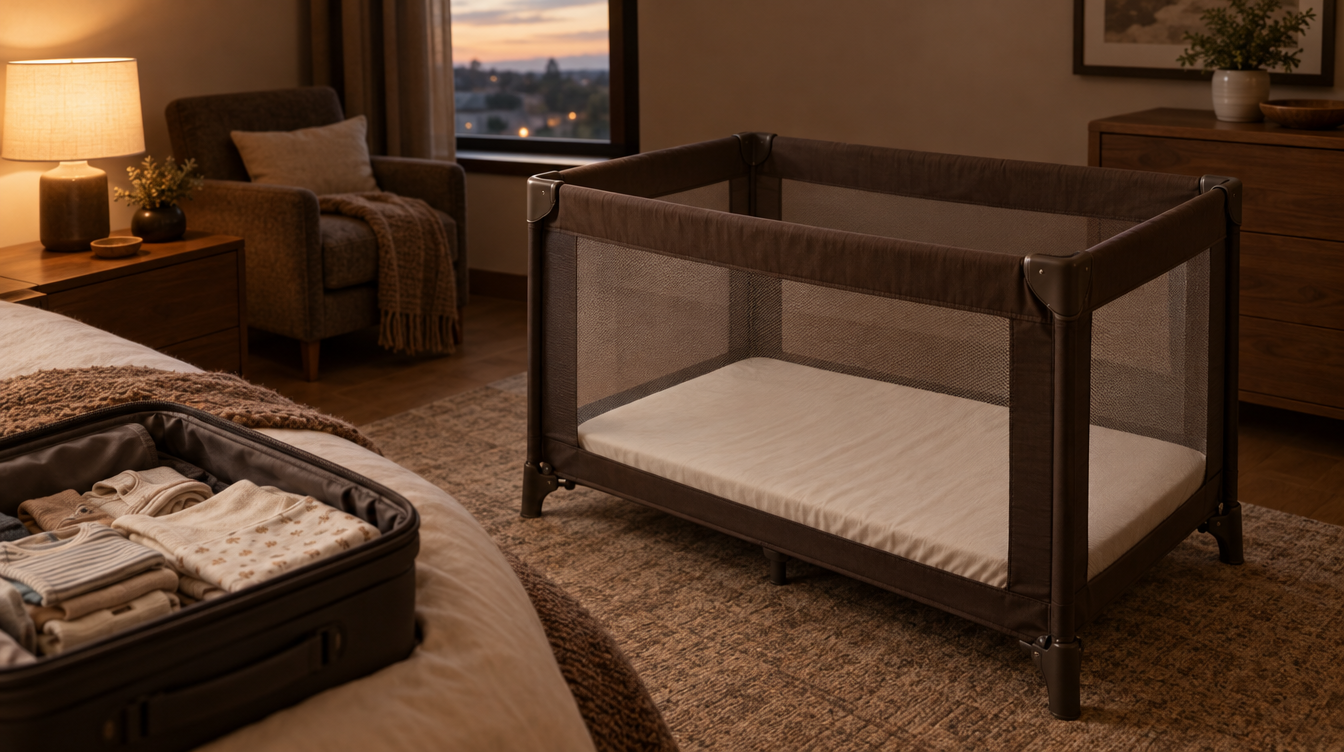
Many hotels and vacation rentals will provide a portable crib if you ask when you book [3]. Relatives may have one in the garage. Either way, a few checks are worth the five minutes.
Check its condition. The AAP suggests making sure it meets current safety standards and is in good repair, with no broken or missing parts, no loose hardware, and no padding other than the manufacturer’s original mattress [3]. The parent guidance adds: don’t use a crib that is missing hardware, is broken or has no instructions, and check the CPSC website for recalls if it is not new [1].
Use the mattress it came with, and nothing else. This is the one parents most often get wrong with good intentions, because the thin play yard pad looks uncomfortable. The CPSC’s advice is to use only the mattress provided with the play yard, or a replacement that names the play yard’s brand and model number; not to add supplemental padding; and never to stack mattresses [4]. Babies have suffocated in gaps between an undersized mattress, or extra padding, and the side walls [4]. The thin pad is the safe one.
Make sure the sheet fits. Bedding should fit the mattress snugly [3]. A full-size crib sheet on a play yard pad will bunch. If you are bringing your own sheet, bring one made for that size.
Look at where it stands. Position the crib away from cords, lamps, televisions and anything that could fall on your baby [3]. Window blind cords in hotel rooms and rentals are easy to miss.
What you can pack: the routine
The research on bedtime routines is one of the more encouraging bodies of evidence in infant sleep, and it is directly useful on a trip.
In a randomized study of 405 mothers with children aged 7 to 36 months, families asked to follow a consistent nightly routine saw fewer and shorter night wakings and faster sleep onset within 3 weeks, and the mothers’ mood improved too [5]. A later survey of mothers of 10,085 children aged 0 to 5 years across 13 countries found that the more consistently families used a bedtime routine, the better their children slept, with earlier bedtimes, fewer night wakings and longer sleep [6]. That second study is observational, so it shows an association rather than proof, but the two point the same way.
What makes a routine useful when traveling is that it is portable. The room changes; the sequence does not. If at home it is bath, pajamas, feed, two books, a song and into the crib, the same order in a hotel bathroom and a play yard tells your baby the same thing it always does: sleep is coming.
A few ways to make the routine travel well:
- Keep the order, shrink the parts. If there is no bathtub, a warm washcloth can stand in for the bath. The sequence matters more than any single step.
- Bring the cues that live in the routine. The same books, the same song, the same sleep sack. The AAP’s hotel guidance suggests a familiar crib sheet as a reminder of home, especially for a baby not used to falling asleep in new places [3]. Keep these cues outside the crib or worn by your baby; soft toys and blankets still stay out of the sleep space for the first year [1].
- Recreate the room where you can. Dimmer light at bedtime, the curtains drawn, the play yard in a quieter corner. If you use a sound machine at home, bringing it keeps one more thing the same; think of it as a familiar cue rather than a fix, and keep it well away from the crib.
- Protect the first nap of the day if you can. Travel days often wreck naps. Getting one reasonable nap on a flat surface makes bedtime less of a fight.
Time zones
There is very little research on jet lag in babies specifically, so I can’t give you an evidence-based protocol. What parents commonly do, and what follows from how the circadian clock works, is this: for a short trip of a few days, some families keep their baby roughly on home time; for longer trips, they shift to local time, using morning daylight, regular meals and the usual routine at the new bedtime as anchors. Either can work. Choose whichever your family can actually sustain.
What to expect
Most babies have a few unsettled nights on a trip: a later bedtime, an extra wake, an early morning. Many settle by the second or third night once the new room becomes familiar, though there is no good research putting numbers on this, and some babies stay unsettled for the whole trip.
Coming home can bring a second, smaller bump. The familiar room helps, and many families find things return to normal within a few nights of the usual routine. If you leaned on extra feeds or rocking during the trip, that is fine; returning to your usual approach at home usually takes a little patience rather than a reset.
A note on illness: travel means new germs. If disrupted sleep comes with fever, ear pulling, poor feeding, breathing trouble or unusual sleepiness, that is not travel disruption. Call your pediatrician, or find local care if you are away.
A note for tonight
If you are reading this in an unfamiliar room with a baby who will not settle, you have not undone anything. They are in a new place and they are telling you about it. Do the routine, put them on their back in the bare play yard, and stay close. If tonight is long, that is the trip, not the future. The only thing that has to go right tonight is where they sleep.
If you’re concerned about your baby’s sleep or health, speak with your pediatrician or family doctor. The American Academy of Pediatrics has sleep safety guidance at healthychildren.org. If your own sleep deprivation is affecting your daily functioning or mental health, that is also worth raising with your doctor.
Frequently asked questions
Is it OK for my baby to share our bed in a hotel just for a few nights?
The AAP recommends against bed sharing under any circumstances, and that does not change on vacation. Its hotel guidance suggests a portable crib or play yard instead, and notes many hotels and rentals have one if you ask when you book.
Can I add a softer pad or a second mattress to a hotel play yard?
No. The CPSC advises using only the mattress that came with the play yard, or one made for that brand and model, never adding extra padding and never stacking mattresses. Babies have suffocated in gaps created by undersized mattresses or extra padding.
My baby fell asleep in the car seat on the drive. Do I have to move them?
Once you arrive and they are out of the car, the AAP says to move a baby who falls asleep in a car seat, stroller, swing or carrier to a firm, flat sleep surface on their back as soon as possible.
Should I keep my baby on home time or switch to the new time zone?
There is very little research on jet lag in babies, so there is no proven rule. Many families keep home time for a short trip and shift gradually for a longer one, using daylight and the usual bedtime routine as anchors.
How long will it take my baby to sleep normally again after a trip?
There is no good research on this. Many parents find sleep settles within a few nights of getting home, once the familiar room and routine are back. If it does not, or if your baby seems unwell, check in with your pediatrician.
Sources and further reading
- Moon RY — How to Keep Your Sleeping Baby Safe: AAP Policy Explained
HealthyChildren.org (American Academy of Pediatrics), parent guidance, last updated September 2026. Plain-language summary of the AAP's 2022 safe sleep policy.
- Moon RY, Carlin RF, Hand I; AAP Task Force on Sudden Infant Death Syndrome — Sleep-Related Infant Deaths: Updated 2022 Recommendations for Reducing Infant Deaths in the Sleep Environment
Pediatrics, 2022;150(1):e2022057990. AAP policy statement on the infant sleep environment.
- McCarthy C — Hotel Safety Tips for Parents of Young Children: Hidden Dangers to Watch For
HealthyChildren.org (American Academy of Pediatrics), parent guidance, last updated June 2026. Covers portable cribs in hotels and rentals and room safety.
- US Consumer Product Safety Commission — Warning on Play Yard Mattresses Sold Separately (Product Safety Warning 25-174)
CPSC product safety warning, March 2025. Includes general reminders: use only the play yard's own mattress or one made for that model, no supplemental padding, never stack mattresses.
- Mindell JA, Telofski LS, Wiegand B, Kurtz ES — A Nightly Bedtime Routine: Impact on Sleep in Young Children and Maternal Mood
Sleep, 2009. Randomized study of 405 mothers and children aged 7-36 months over 3 weeks; a consistent bedtime routine reduced night wakings and improved maternal mood.
- Mindell JA, Li AM, Sadeh A, Kwon R, Goh DYT — Bedtime Routines for Young Children: A Dose-Dependent Association with Sleep Outcomes
Sleep, 2015. Cross-sectional survey of mothers of 10,085 children aged 0-5 years in 13 countries; more consistent routines were associated with better sleep outcomes.
Sources checked October 29, 2026. This is an editorial summary, not a systematic review or individual advice.